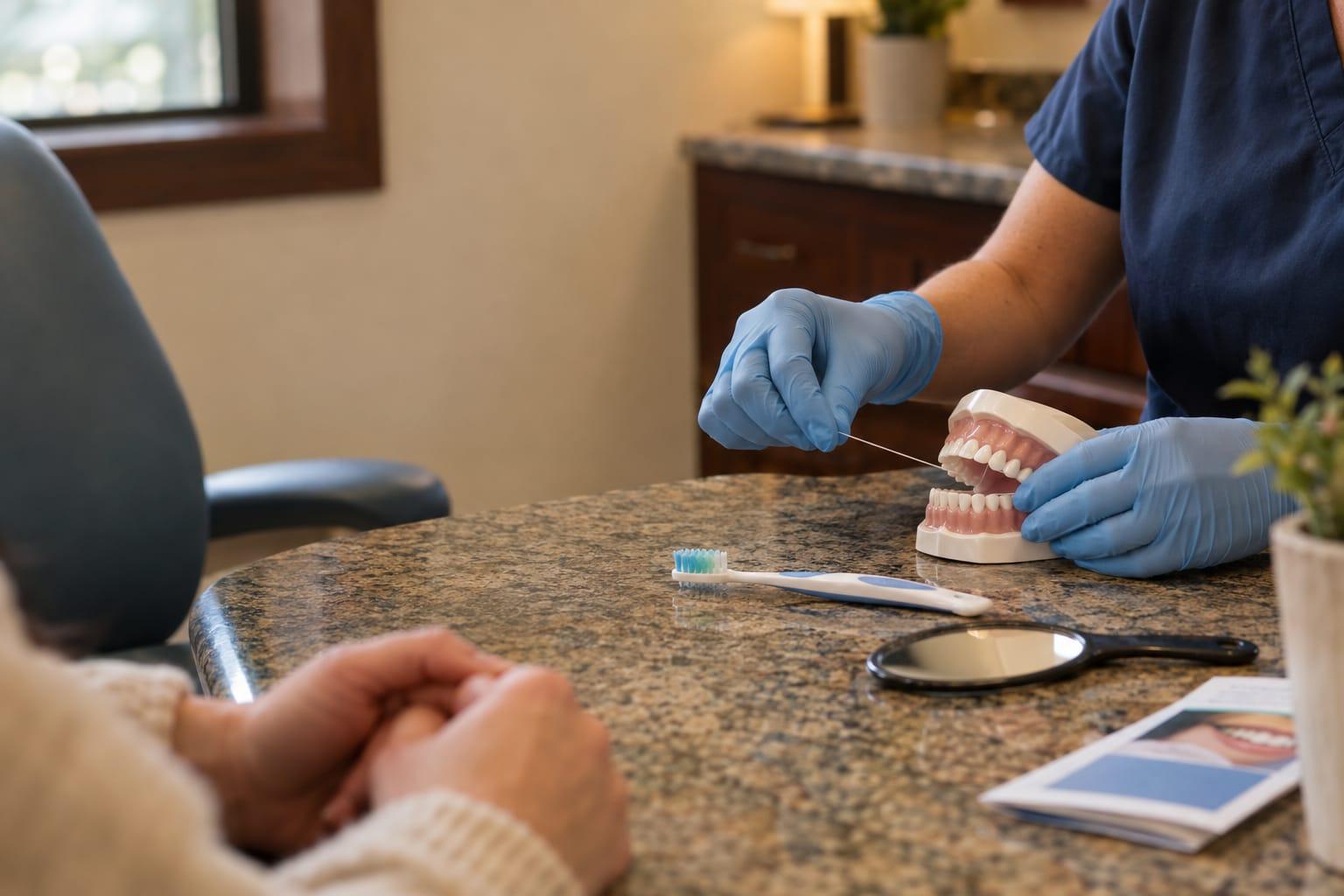

If you live in Glenview, it is easy to treat your mouth as something separate from the rest of your health. You keep up with your physician, you pay attention to how you feel, and you might still put off a dental visit because nothing is bothering you. In late October, Cleveland Clinic marked National Dental Hygiene Month with a reminder from dentist Anne Clemons, D.M.D., that the mouth is not off to the side of the body. It is the starting point of your digestive system and your respiratory tract. As a dentist in Glenview, IL, that is how we think about your care, too.
Why oral health is so often set aside
Dr. Clemons put the habit plainly: people tend to place oral health in one category and the rest of the body in another, even though the two belong together. We see the same pattern in our own conversations. A parent juggling a fall calendar, a commuter on the Edens Expressway, or someone who feels fine at breakfast can reasonably conclude that the teeth can wait. The trouble is that gum disease and early decay often give very little warning.
That does not mean you have done something wrong. It means the mouth is easy to overlook until a problem is already under way. Our role, as your neighbors on Ravine Way, is to look carefully, explain what we see, and help you decide what, if anything, needs attention. There is no pressure in that conversation.
What plaque and gum disease can mean
Plaque is a sticky film that forms on teeth. As Cleveland Clinic notes, it contains food particles, bacteria, and saliva. When it builds up, it can contribute to cavities, persistent bad breath, and gum disease. The Centers for Disease Control and Prevention explains that bacteria in the mouth live in that film, and that plaque which is not removed can harden into tartar, also called calculus. Tartar cannot be brushed away at home. It needs to be removed during a professional cleaning.
Gum disease is a broad term, and the distinction between its stages matters. Gingivitis is inflammation of the gums. The gums may look red or swollen and may bleed when you brush or floss. The CDC describes gingivitis as largely preventable and treatable, and as a reversible condition when it is addressed with daily cleaning and professional care. The National Institute of Dental and Craniofacial Research similarly notes that early gum disease caused by plaque buildup can often be turned around with daily brushing and flossing, along with professional care when it is needed.
If gingivitis is left untreated, it can progress to periodontitis. In periodontitis, inflammation reaches the tissues and bone that hold the teeth in place. The CDC is careful here: periodontitis involves bone loss, and it cannot be reversed, though it can be slowed and managed with professional treatment. The American Dental Association's MouthHealthy site describes this later stage as a major cause of tooth loss in adults. According to the CDC, about 4 in 10 U.S. adults age 30 or older had some level of periodontitis in 2009 to 2014, and about 60 percent of adults 65 and older had it in that same period.
You may not feel a clear signal early on. The CDC notes that gum disease can become serious before a person notices symptoms, and MouthHealthy points out that it is possible to have gum disease without obvious warning signs. When signs do appear, they may include gums that bleed, look red or swollen, or have pulled away from the teeth; persistent bad breath; loose or sensitive teeth; or a change in the way the teeth fit together when you bite. If you notice any of those changes, it is worth having them checked. If you do not notice anything, a regular exam still has a purpose: it is often how early problems are found.
How a dentist in Glenview, IL looks at the whole picture
When we sit down with you at our office in Glenview, we are not only looking for cavities. We look at the gums, the way the teeth come together, and the condition of existing fillings, crowns, or partials. We also listen to what you have been noticing at home, including bleeding when you brush, a change in how a partial fits, or a jaw that feels tired in the morning. That complete look is part of how we practice, and it is one reason long-time patients of Dr. Susan Graber still find a familiar, unhurried exam in the same office, with the same team and their records still here.
The mouth-body connection is real, and it should be described honestly. Dr. Clemons told Cleveland Clinic that people with periodontal disease and people with heart disease more commonly have both, even when other shared risk factors are taken into account, and that researchers still do not know exactly how those conditions are connected. MouthHealthy makes a similar point: research is ongoing, a link is not conclusive, and some studies suggest that severe gum disease may be associated with other conditions such as diabetes or stroke. We will not overstate that science. We will say that caring for your gums is worthwhile on its own, and that it is one part of looking after your overall health.
Certain factors make gum disease more likely. The CDC lists associations with smoking, diabetes, less consistent oral hygiene, stress, genetics, hormonal changes, and teeth grinding or clenching, among others. NIDCR describes tobacco use as the most significant risk factor and notes that it can also delay healing. None of those factors is a reason for embarrassment. They are simply useful context when we examine your mouth and talk through a plan that fits your life.
For families and adults who see us from downtown Glenview, The Glen, or nearby communities such as Northbrook and Wilmette, that plan usually starts with prevention. Our preventive dentistry visits include exams and cleanings, and we look closely for early decay and for changes in the gums. When we find an early cavity, we can talk about options that may include a drill-free treatment called Curodont, when it is appropriate, or a tooth-colored filling if a restoration is the better choice. When the gums need more attention, we offer gum therapy and explain what we are seeing before we recommend a next step. If a tooth is worn, cracked, or missing, we can also discuss crowns, bridges, partials, or dental implants, always at the pace of a clear conversation.
If you have a specific concern, from bleeding gums to a change in your bite, you can also read more about the dental problems we treat and then come in so we can look at your own mouth rather than asking you to self-diagnose.
Habits that help between visits
Established guidance on daily care is straightforward, and it is consistent across the sources above. Cleveland Clinic recommends brushing at least twice a day for two minutes and flossing once a day, and keeping up with dental appointments. The ADA likewise encourages brushing twice a day, cleaning between the teeth daily, eating a balanced diet, and scheduling regular visits. NIDCR advises brushing twice a day with a fluoride toothpaste, cleaning between the teeth regularly, and seeing a dentist for routine checkups and professional cleanings.
We will not turn those points into a rigid routine you have to follow perfectly. What matters is a habit you can keep, and a visit schedule that matches your needs. Some people do well with a typical checkup interval; others, including people with gum disease, diabetes, or a history of heavy plaque, may be asked to come more often. That recommendation should come from an exam, not from a generic rule.
Diet, tobacco, and alcohol also play a role, as Dr. Clemons noted. If those are part of your life, we can talk about them without judgment and focus on what will help your mouth the most right now. If you want guidance that is tailored to your teeth, your gums, and your medical history, contact our office and we will sit down with you.
Frequently asked questions
If nothing hurts, should I still see a dentist near Glenview?
Yes. Gum disease and early decay often develop with little discomfort, which is why they are easy to miss. The CDC notes that gum disease can become serious before symptoms are obvious, and a regular checkup is one of the more reliable ways to find changes early. If you live in Glenview or you drive in from a nearby community, an exam gives us a chance to look at your gums and teeth while treatment, if it is needed, is usually simpler.
Can early gum disease be turned around?
Early gum disease, or gingivitis, is generally considered reversible with professional cleaning and steady daily care, according to the CDC, NIDCR, and the ADA. Periodontitis, the later stage that involves bone loss, cannot be reversed, but it can be slowed and managed with professional treatment. The right next step depends on what we see in your mouth, which is why an exam matters more than a general description.
How often should I visit a dentist in Glenview, IL?
There is no single interval that fits every person. Many adults do well with routine exams and cleanings, and people with gum disease, certain medical conditions, or a tendency to build plaque quickly may need to be seen more often. We will look at your gums, your medical history, and how things have changed since your last visit, then recommend a schedule that makes sense for you.
If you have been meaning to get back into dental care, or if you are new to the area and looking for a dentist in Glenview, IL, we would be glad to see you. Our office is at 2440 Ravine Way, Suite 400, in Glenview, and you can reach us at (847) 729-7711. You can find us on Google Maps, Apple Maps, or Yelp, and you can contact us to ask a question or request a time that works for you. Whether you are a long-time patient of this practice or you are visiting us for the first time, we will take the time to look carefully, explain what we see, and help you take care of your mouth as part of the rest of your health.